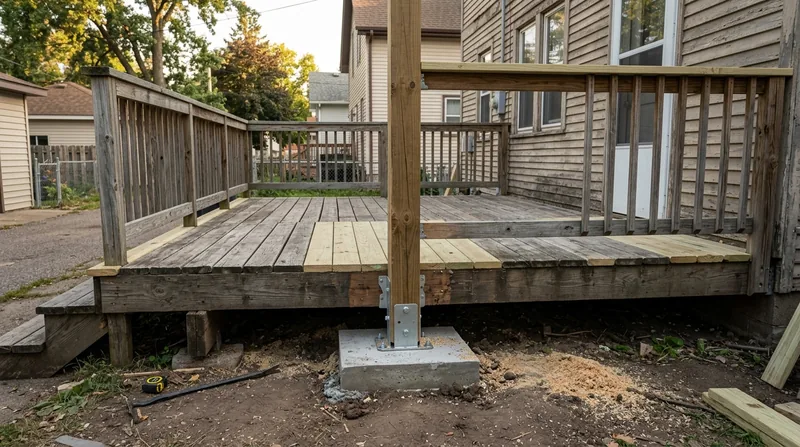




Minneapolis decks and porches face relentless punishment from Minnesota's freeze-thaw cycles and heavy snow load. Winter cold cracks framing, spring thaw drives moisture deep into wood grain, and repeated cycles split posts, rot treads, and heave stairs out of square year after year. Deck and porch repair in Minneapolis is not cosmetic work, it is structural maintenance that keeps outdoor spaces safe and usable through the brutal continental climate. We replace rotted boards and posts, repair structural framing and railings, and fix stairs and skirting, always starting with honest repair and moving to replacement only when the wood has failed too far to justify anything else. Our approach is straightforward: we show you what is wrong, explain what caused it, and tell you plainly what it will cost to fix.
Why Freeze-Thaw Damage Destroys Decks and Porches in Minneapolis
The Twin Cities sits on flat glacial terrain dotted with lakes and connected by parkways, a landscape carved by ice age forces that still drive the climate today. Winter temperatures drop well below zero for weeks at a time, snow accumulates in heavy wet loads, and spring thaw arrives fast and wet. Wood exposed to this cycle absorbs water, freezes solid, expands, thaws, and shrinks again, over and over, every single year. The stress splits grain, opens joints, and splits nails. Moisture works into the cracks and stays there, triggering rot in posts, rim joists, deck boards, and porch substructure. Left unaddressed, rot spreads fast and compromises the structural integrity of the entire deck or porch.
- Water penetrates exposed grain and open joints during thaw season, especially on south and west facing surfaces that experience the most temperature swings.
- Freeze cycles expand water in the wood grain, splitting boards and opening the wood to deeper water infiltration the next year.
- Rot fungi colonize the wet wood and break down cellulose, turning solid framing into soft punky material that cannot support weight.
- Loose railings, sagging treads, and bouncy deck boards signal structural failure and create real safety hazards.
- Damage compounds over time, turning a single rotted board into a full structural replacement if ignored too long.
Early repair stops the cycle and keeps your deck or porch solid for years to come.
Key info: South Minneapolis Craftsman bungalows and Foursquares in Kingfield and Tangletown often have original wood porches built a century ago, still carrying load but showing rot in the rim joist and skirting board. Kenwood and Linden Hills Tudor Revival homes around the Chain of Lakes have grand screened porches and decks that demand precision repair to preserve their character. Northeast Minneapolis Arts District duplexes and Powderhorn working-class triplexes have back decks and stairs that see heavy use and heavy weather exposure. All are vulnerable to the same freeze-thaw damage, and all benefit from honest repair-first assessment.
For detailed information on permitting and structural requirements, check the City of Minneapolis Building Permits page, which outlines when structural work requires a permit and city inspection.
How We Assess and Repair Decks and Porches in Minneapolis
We start every job with a detailed walkthrough and visual inspection, poking suspect wood with a screwdriver to gauge rot depth, checking for soft spots in treads and posts, and testing railings for loose bolts and movement. We photograph the damage, document what we find, and explain the repair options before we pick up a tool. Repair means replacing only the damaged wood, sistering new framing alongside rotted joists, or splicing sound wood into a partially compromised board. Replacement means taking out the entire assembly and building new, and we recommend it only when repair will not hold or when the cost of repair approaches the cost of replacement.
- We inspect the substructure, posts, and sill plate for rot and structural integrity, checking for water damage and frost heave that lifts or tilts the deck.
- We test railings and balustrades for code compliance, loose bolts, and cracked newel posts or balusters that compromise safety.
- We assess stairs for heaved or cracked treads, loose stringers, and rot in the stringer framing that supports the tread load.
- We document rot depth and extent using field-proven techniques, not drama, so you understand what failed and why.
- We propose repair work first, detailing exactly which boards or joists we will replace and which we will reinforce, and we explain the cost and timeline upfront.
This methodical approach means you never pay for unnecessary replacement and you understand the work before we start.
Example: A 1970s rambler in Richfield has a rear deck with a soft spot in the rim joist where water pooled against the house foundation. Rather than tearing out the entire 16 by 12 foot deck, we sister a new rim joist alongside the rotted one, bolt it securely, and replace only the three feet of rim joist that showed significant decay. The deck treads stay, the ledger stays, and the cost is a fraction of a full replacement. That is repair-first thinking.
For complex structural issues like load-bearing posts or major joist replacement, see our detailed floor joist and subfloor repair page, which covers sistering and joist reinforcement in depth.
| Repair Approach | Description | Best for |
|---|---|---|
| Board Replacement | Remove and replace individual deck boards, fascia, or skirting that show surface rot or split grain. | Isolated rot in treads, deck boards, or fascia that has not spread to the framing beneath. |
| Joist and Post Sistering | Bolt new pressure-treated framing alongside rotted rim joists, floor joists, or posts to restore load capacity without removing the existing structure. | Rot in the lower rim joist or posts where the entire deck frame is still level and the damage is localized to one section. |
| Stair Tread and Stringer Repair | Replace cracked or soft treads, reinforce stringers, and reset loose bolts to restore safe stair geometry and tread support. | Heaved or split treads, loose stairs, or minor rot in stringer framing where the overall stair assembly is still plumb and square. |
| Railing and Balustrade Repair | Replace cracked balusters, tighten or replace bolts at newel posts, and reinforce rail framing to meet current code and restore safety. | Loose or cracked railings, split balusters, or rotted newel posts where the main rail and post structure is still sound. |
| Full Deck or Porch Replacement | Remove the entire assembly and build new, matching the original footprint, height, and design as closely as the client prefers. | Rot damage too extensive to repair economically, frost heave that has tilted the entire structure, or when the client wants modern materials or design. |
Deck and Porch Repair Cost in Minneapolis: What to Expect
Deck and porch repair costs in Minneapolis start at around $900 for simple board replacement, such as a single cracked tread or a few rotted deck boards. Joist sistering and structural reinforcement typically run $1,500 to $3,500 depending on the length of the joist, access difficulty, and whether the deck must be temporarily shored during work. Full deck or porch replacement, which is common when rot has spread through multiple structural members or when frost heave has tilted the frame, usually costs $4,000 to $12,000 or more, depending on the deck size, height, and material choices. A railing repair might cost $600 to $1,200 if it is just new balusters and bolts, or $2,000 to $4,000 if the newel post or rail framing needs replacement.
The cost of your specific job depends on several concrete factors. The size and height of the deck or porch set the scope: a small 8 by 10 foot back porch is less material and labor than a large 20 by 16 foot elevated deck. The extent of rot matters most: a single soft spot in the rim joist costs far less to repair than rot that has spread across multiple joists and posts. Access and site conditions affect labor time, particularly if the deck is high off the ground, surrounded by landscaping, or attached to a historic home that requires careful work around siding and trim. Material choice makes a difference too, especially if you choose pressure-treated lumber, cedar, composite decking, or other alternatives. Snow load and weather delays in winter can extend timelines and add cost.
We recommend getting two or three estimates from local carpenters so you can compare approach, material choices, and pricing. An honest estimate should include a site visit, a detailed description of the work and materials, a clear timeline, and a total price or a detailed hourly rate with an estimated range. Avoid estimates that do not include a site visit or that quote a price over the phone without seeing the damage. For a full breakdown of our pricing by service type and a free estimate, visit our pricing page or call us at (612) 441-4671.
Deck and Porch Repair Near Me: What to Look for When Hiring a Carpenter in Minneapolis
Hiring a local carpenter for deck and porch repair means finding someone who understands the Minneapolis climate, knows the building code, and has real experience with freeze-thaw damage and structural repair. A good carpenter will listen to your concerns, inspect the damage carefully, and explain the repair options in plain language without pushing you toward the most expensive choice. They will also be fully insured, able to pull permits if the work requires them, and willing to provide references from past jobs in your neighborhood.
Start by asking for proof of insurance coverage, including general liability and workers compensation. Check that the carpenter is familiar with Minneapolis building code and willing to work with the city building department if permits are needed for structural work. Ask for references from homeowners in your area, particularly those with older homes like yours, and follow up with a phone call or email to confirm the work quality and professionalism. Understand which parts of the job require a permit: structural repairs to load-bearing posts, joist replacement, and alterations to stairs or railings often need city inspection, and requirements vary by the scope of work. Ask about the carpenter's approach to repair versus replacement, and make sure they explain why they recommend what they recommend. If your home is in a historic district or protected neighborhood, confirm that the carpenter understands local design guidelines and can source materials that match the original.
Get written estimates from at least two or three local carpenters before making a decision. The lowest price is not always the best value, particularly if the estimate does not include a detailed site inspection or if the carpenter seems rushed or dismissive of your concerns. A thorough estimate takes time, includes photos or notes from the inspection, describes the exact work and materials, and gives you a clear timeline and total price. For a free estimate from our team, call us at (612) 441-4671 or visit our contact page to request a walkthrough. We respond within 24 hours and there is no obligation to book.
Deck & Porch Repair in Minneapolis: Pricing Guide
| Service | Price | Details |
|---|---|---|
| Single board replacement | Starting at $900 | One or two cracked treads, fascia boards, or deck boards, includes material, labor, and fasteners |
| Joist sistering and structural reinforcement | Starting at $1,500 | New pressure-treated joist bolted alongside rotted rim or floor joist, cost increases with joist length and site access difficulty |
| Stair and railing repair | Starting at $800 | Tread replacement, stringer reinforcement, baluster replacement, or railing tightening, cost depends on number of components and rot extent |
| Full deck or porch replacement | On estimate | Entire assembly removal and rebuild, cost driven by deck size, height, material choice, and site complexity, requires site inspection |
| Travel and site visit | Included | Free inspection and estimate in Minneapolis and surrounding service area, no mileage fee or call-out charge |
| Estimate | Free | No-obligation site inspection and written estimate, response within 24 hours, call (612) 441-4671 |
Indicative pricing, the exact cost depends on square footage, finish, and site access. Free personalized estimate within 24h at (612) 441-4671.


